



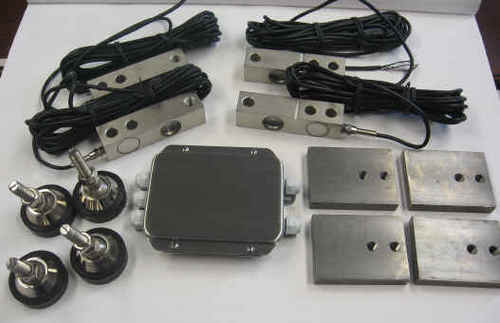
LOAD CELLS OVER ANALOG LOAD CELLS
Product Details:
- Resistance 350
- Output Analog
- Theory Resistance Sensor
- Type Load Cell
- Accuracy 0.025% F.S.
- Operating Voltage 10V DC
- Output Voltage 2mV/V
- Click to View more
LOAD CELLS OVER ANALOG LOAD CELLS Product Specifications
- -20C to +60C
- Load Cell
- 2mV/V
- 350
- Resistance Sensor
- 0.025% F.S.
- 10V DC
- -10C to +40C
- -10C to +40C
- Analog
- >5000 M (50V DC)
- 5-15V DC
- <0.02% F.S. over 30 min
- Industrial Weighing, Process Automation
- 5kg to 500kg
- <0.017% F.S.
- IP65
- Alloy Steel
- 150% F.S.
- <0.02% F.S.
- 200% F.S.
- 2 meters
Product Description
| POINTS | DIGITAL LOAD CELL | ANALOG LOAD CELL |
| Accuracy |
Each DLC has an individual A/D converter. This helps in generating higher internal counts for the total system and hence a lower division size can be achieved leading to higher accuracy.
| Signals of all 4/6/8 load cell are shorted and connected to a single A/D converter in the indicator. This leads to a smaller number of internal counts from the ADC which leads to a high value of division size and hence lesser accuracy.
|
| Electrical Noise
| ADC and micro controller are built in the load cell & the output is serial digital signal. There is no effect of electrical noise even if the load cell cable is long or the environment is electrically noisy.
|
Output of combined analog load cell is from 0.1 µv to 3 µv per unit load. This is a very small and sensitive signal which is sensitive to any electrical noise present around the cable and indicator and may lead to unstable weight display if the cable length is long or the environment is electrically noisy.
|
| Calibration |
Are pre calibrated with weight and hence no calibration is required in the field. Only a small corrective calibration may be required if there is major structure deformity.
| Calibration has to be done in the field using test weights. This is a very expensive and cumbersome process.
|
| No Corner Error | As every load is pre-calibrated in the factory, there is no corner error during installation or even with regular usage.
|
Corner has to be tested and removed manually which is a very tedious and expensive process. If corner errors are generated during regular usage, it is very difficult to find and remove these as it will require operator and engineer skills.
|
| Replacement | Since the DLC are pre-calibrated in the factory, it can be easily replaced in the field without the hassle of scale calibration or corner error removal. Even if a different capacity load cell is used for replacement, the result is the same.
| If any ALC is replaced in the field, it will require scale calibration with weights and also corner error removal. This is because the load cells have variation in their analog outputs which has to be matched with the other load cells used in the scale.
|
| Distance between load cell & indicator | As the output signal is digital, the distance between load cells & indicator can be as long as 500m without use of signal repeaters.
|
As the output is analog with values in micro volt, the same is very sensitive to electrical noise pick-ups. Under this circumstance, the distance between load cells and indicator is limited to 20 meters. |
High-Precision Industrial Sensing Solution
Engineered with advanced resistance sensor theory, our Alloy Steel Analog Load Cells ensure precision with a non-linearity of less than 0.017% F.S. and accuracy up to 0.025% F.S. This makes them ideal for critical industrial weighing and automation scenarios, offering consistent and repeatable outputs even in demanding environments.
Durable and Reliable for Harsh Conditions
With IP65 ingress protection, high insulation resistance (>5000 M), and rugged alloy steel construction, these analog load cells are tailored for long-lasting performance. The safe and ultimate overload thresholds (150% and 200% F.S.) allow for operational flexibility without compromising measurement reliability.
FAQs of LOAD CELLS OVER ANALOG LOAD CELLS:
Q: How are these analog load cells typically used in industrial settings?
A: Analog load cells are widely applied in industrial weighing systems and process automation, providing precise force or weight measurements for batching, filling, packaging, and material handling applications.Q: What are the advantages of using an alloy steel analog load cell over other materials?
A: Alloy steel construction ensures exceptional strength, durability, and long service life, enabling the load cell to withstand heavy loads, harsh environments, and frequent operational demands without degradation.Q: When should I choose analog load cell technology for my application?
A: Analog load cells are ideal when you require high accuracy, stable output, and easy integration with standard analog weighing or control systems, particularly in industrial automation setups.Q: Where can these load cells be installed for optimal performance?
A: These load cells are suitable for installation in protected industrial areas such as tank scales, platform scales, hopper systems, and automated machinery, where environmental ingress is controlled (IP65 rating).Q: What is the process for integrating these load cells into an existing system?
A: Integration involves securely mounting the load cell, connecting the 2-meter cable to an analog weight indicator or signal processing equipment, and applying the specified excitation voltage (10V DC typical, 515V DC supported) for signal output.Q: How do I benefit from the low creep and hysteresis specifications of this product?
A: Low creep (<0.02% F.S. over 30 min) and hysteresis (<0.02% F.S.) ensure consistent and repeatable measurements over long periods, reducing drift and enhancing long-term process reliability in industrial operations.
Price:
- 50
- 100
- 200
- 250
- 500
- 1000+

Other Products in 'Loadcell' category


- B No 166 167, GROUND, KOTARPUR WATER WORKS, SARDANAGAR,Ahmedabad - 382475, Gujarat, India
- Phone : 08045476195
GST : 24ACRPP5314R1ZV

- Mr Harshad bhai Patel (Director)
- Mobile : 08045476195
- Send Inquiry
 Send Inquiry
|

Developed and Managed by Infocom Network Private Limited.

